> For the complete documentation index, see [llms.txt](https://help.connected.illumina.com/llms.txt). Markdown versions of documentation pages are available by appending `.md` to page URLs; this page is available as [Markdown](https://help.connected.illumina.com/emedgene/emedgene-curate-manual/curate_variant_annotations_in_the_case.md).

# Curate annotations in a case

Variants in your organization’s **Curate** database can show curated data on the **Variant page** and in the **Variant table**.

**Curate** variant annotations include:

* [Pathogenicity](#pathogenicity)
* [ACMG classification](#acmg-classification)
* [Variant interpretation](#variant-interpretation)
* [Curated variants visualization tracks](#visualization)

**Curate** gene annotations include:

* [Reference transcript for a gene](#selected-transcript)
* [Gene interpretation](#gene-interpretation)

**Curate** data is identified by these indicators:

* **Curate symbol** (<img src="https://1131024994-files.gitbook.io/~/files/v0/b/gitbook-x-prod.appspot.com/o/spaces%2FGCW0DnLlE7QjoZPNmKIi%2Fuploads%2Fgit-blob-a3bd5cc60f23cc89f5e07631084fee49ad38ec19%2Fimage%20(162).png?alt=media" alt="" data-size="line">): Appears next to data sourced from **Curate**.
* **Curate pathogenicity badge:** A color-coded badge that identifies variant pathogenicity sourced from **Curate**.

## Prerequisites

For **Curate** annotations to appear in a case, the variant or gene must:

* Have a record in your organization’s **Curate** database. Network-only variants do not display **Curate** annotations in **Analyze** unless [imported](/emedgene/emedgene-curate-manual/curate_variants/curate_variant_page/network-summary-card.md#how-to-import-a-network-only-variant).
* Be a [supported type](/emedgene/emedgene-curate-manual/curate_variants.md#variants-supported-in-curate) for variants.
* Have an annotation-enabled curation status (v100.41.0+).

## Variant annotations

### Pathogenicity

Variant pathogenicity stored in **Curate** is displayed:

* In the **Known Variants** column of the **Variant table** (Fig. 1)
* On the **Variant page**:
  * In the **Summary tab** (Fig. 2)
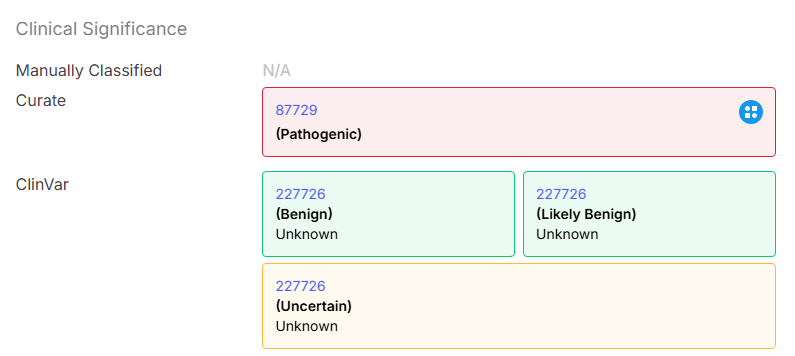
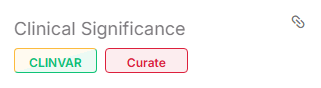
  * In the **Clinical Significance tab** (Fig. 3)
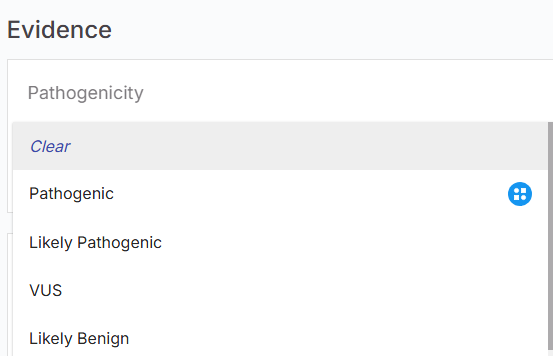
  * In the **Evidence tab** (Fig. 4)
<div data-with-frame="true"><img src="https://1131024994-files.gitbook.io/~/files/v0/b/gitbook-x-prod.appspot.com/o/spaces%2FGCW0DnLlE7QjoZPNmKIi%2Fuploads%2Fgit-blob-779acb6883eab530aa9169433da25c0629f026a8%2Fvt.png?alt=media" alt="Figure 1. Curate pathogenicity badge in the Known Variants column of the Variant table."></div>

<div align="left" data-with-frame="true"><figure><img src="https://1131024994-files.gitbook.io/~/files/v0/b/gitbook-x-prod.appspot.com/o/spaces%2FGCW0DnLlE7QjoZPNmKIi%2Fuploads%2Fgit-blob-ce427ef5abcdac906fcfff9a213d02a2089c5651%2FNCS.png?alt=media" alt="Fig. 2. Curate pathogenicity badge in the Summary tab of the Variant page."><figcaption><p>Figure 2. <strong>Curate</strong> pathogenicity badge in the <strong>Summary tab</strong> of the <strong>Variant page</strong>.</p></figcaption></figure></div>

<div align="left" data-with-frame="true"><figure><img src="https://1131024994-files.gitbook.io/~/files/v0/b/gitbook-x-prod.appspot.com/o/spaces%2FGCW0DnLlE7QjoZPNmKIi%2Fuploads%2Fgit-blob-bbf87f7e0f827c242774602e1aa3c26121621597%2Funcertain.png?alt=media" alt="Fig. 3. Curate symbol indicating curated pathogenicity in the Clinical Significance tab of the Variant page." width="563"><figcaption><p>Figure 3. <strong>Curate</strong> symbol indicating curated pathogenicity in the <strong>Clinical Significance tab</strong> of the <strong>Variant page</strong>.</p></figcaption></figure></div>

<div align="left" data-with-frame="true"><figure><img src="https://1131024994-files.gitbook.io/~/files/v0/b/gitbook-x-prod.appspot.com/o/spaces%2FGCW0DnLlE7QjoZPNmKIi%2Fuploads%2Fgit-blob-ee15af619991ef0772df37f051656c10651076ac%2FEVI.png?alt=media" alt="Fig. 4. Curate symbol indicating curated pathogenicity in the Evidence tab of the Variant page." width="415"><figcaption><p>Figure 4. <strong>Curate</strong> symbol indicating curated pathogenicity in the <strong>Evidence tab</strong> of the <strong>Variant page</strong>.</p></figcaption></figure></div>

### ACMG classification

ACMG classification stored in **Curate** is automatically applied to small variants. This includes:

* Tag status
* Tag strength
* Answers to tag questions
* Tag notes

ACMG classification from **Curate** appears on the **Variant page**:

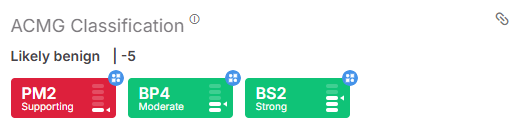
* In the **Summary tab** (Fig. 5)
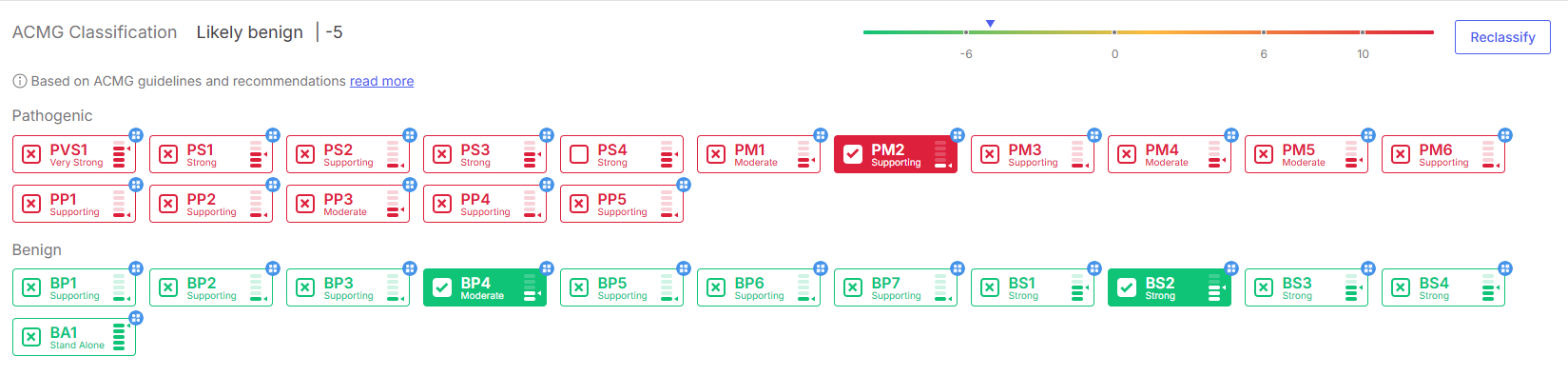
* In the **Evidence tab** (Fig. 6)

<div align="left" data-with-frame="true"><figure><img src="https://1131024994-files.gitbook.io/~/files/v0/b/gitbook-x-prod.appspot.com/o/spaces%2FGCW0DnLlE7QjoZPNmKIi%2Fuploads%2Fgit-blob-3b34ae9b2e1b8acc3baf131f7072c9b9fdc030b8%2Facmg%20classification%20summary.png?alt=media" alt="Fig. 5. Curate icon for ACMG classification in the Summary tab."><figcaption><p>Figure 5. <strong>Curate</strong> symbols indicating curated ACMG tags in the <strong>Summary tab</strong> of the <strong>Variant page</strong>.</p></figcaption></figure></div>

<div align="left" data-with-frame="true"><figure><img src="https://1131024994-files.gitbook.io/~/files/v0/b/gitbook-x-prod.appspot.com/o/spaces%2FGCW0DnLlE7QjoZPNmKIi%2Fuploads%2Fgit-blob-21b5e628e86f8af97dcebc2d6da82bb9f2cca5cc%2Facmg%20classification%20evidence.png?alt=media" alt="Fig. 6. Curate icon for ACMG classification in the Evidence tab."><figcaption><p>Figure 6. <strong>Curate</strong> symbols indicating curated ACMG criteria in the <strong>Evidence tab</strong> of the <strong>Variant page</strong>.</p></figcaption></figure></div>

### Variant interpretation

You can import curated variant interpretation into **Variant interpretation notes**. See [**Import Curate variant interpretation to the case**](/emedgene/emedgene-curate-manual/curate_variant_annotations_in_the_case/import_curate_variant_annotations_to_the_case_-300+.md).

### Visualization tracks

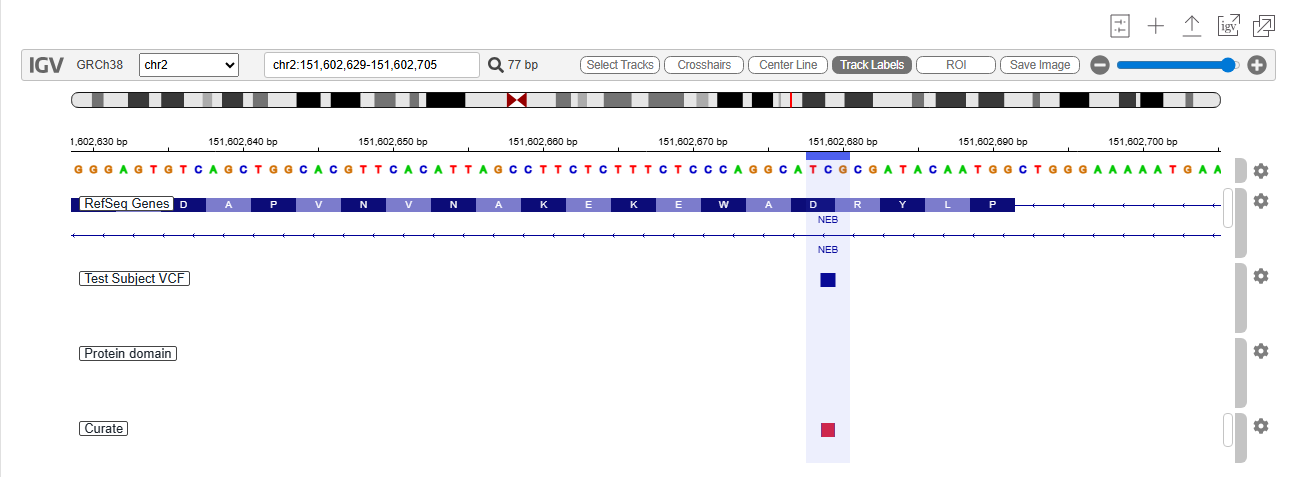
When enabled, **Curate** and **CurateSV** [visualisation tracks](/emedgene/emedgene-analyze-manual/variant-visualization/variant-visualization-tool/visualization-tracks/curated-data-tracks.md) show **Curate** variants alongside alignment data in the **Visualization tab** (Fig. 7).

<div align="left" data-with-frame="true"><figure><img src="https://1131024994-files.gitbook.io/~/files/v0/b/gitbook-x-prod.appspot.com/o/spaces%2FGCW0DnLlE7QjoZPNmKIi%2Fuploads%2Fgit-blob-f3a7716f6bf170e780056bc6e2e72aa12a29e4d0%2FIGV.png?alt=media" alt="Fig. 7. Curate visualisation track in the Visualization tab of the Variant page."><figcaption><p>Figure 7. <strong>Curate</strong> visualisation track in the <strong>Visualization tab</strong> of the <strong>Variant page</strong>.</p></figcaption></figure></div>

## Gene annotations

### Reference transcript for a gene

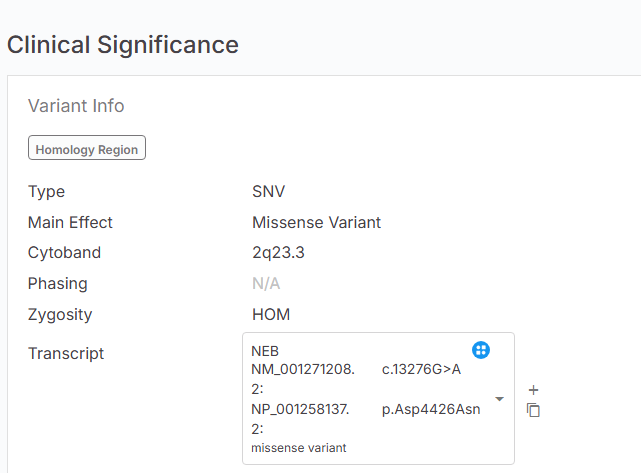
The reference transcript set for a gene in **Curate Genes** is marked with a **Curate** symbol in the **Clinical Significance tab** of the **Variant page** (Fig. 8).

<div align="left" data-with-frame="true"><figure><img src="https://1131024994-files.gitbook.io/~/files/v0/b/gitbook-x-prod.appspot.com/o/spaces%2FGCW0DnLlE7QjoZPNmKIi%2Fuploads%2Fgit-blob-e49d70ad86b0b32e74a8bdc52b4ae86f71dd8f3c%2FT.png?alt=media" alt="Fig. 8. Curate symbol indicating selected transcript in the Clinical Significance tab of the Variant page." width="481"><figcaption><p>Figure 8. <strong>Curate</strong> symbol indicating the selected transcript in the <strong>Clinical Significance tab</strong> of the <strong>Variant page</strong>.</p></figcaption></figure></div>

### Gene interpretation

You can import curated gene interpretation into the **Gene Interpretation tab** or **Variant interpretation notes**. See [**Import Curate gene interpretation to a case**](/emedgene/emedgene-curate-manual/curate_variant_annotations_in_the_case/import_curate_gene_annotations_to_the_case_-300+.md).


---

# Agent Instructions
This documentation is published with GitBook. GitBook is the documentation platform designed so that both humans and AI agents can read, navigate, and reason over technical content effectively. Learn more at gitbook.com.

## Querying This Documentation
If you need additional information that is not directly available in this page, you can query the documentation dynamically by asking a question.

Perform an HTTP GET request on the current page URL with the `ask` query parameter, and the optional `goal` query parameter:

```
GET https://help.connected.illumina.com/emedgene/emedgene-curate-manual/curate_variant_annotations_in_the_case.md?ask=<question>&goal=<endgoal>
```

`ask` is the immediate question: it should be specific, self-contained, and written in natural language.
`goal` is optional and describes the broader end goal you are ultimately trying to accomplish on behalf of the user. GitBook uses it to tailor the answer towards what is most useful for that goal.

The response will contain a direct answer to the question and relevant excerpts and sources from the documentation.

Use this mechanism when the answer is not explicitly present in the current page, you need clarification or additional context, or you want to retrieve related documentation sections.