# Curate Variant table

The **Curate Variant Table** is your central view of all variants stored in your organization’s Curate database. It provides quick access to variant details, pathogenicity, and search tools, with clear counts of curated records to make tracking easier.

![](https://1131024994-files.gitbook.io/~/files/v0/b/gitbook-x-prod.appspot.com/o/spaces%2FGCW0DnLlE7QjoZPNmKIi%2Fuploads%2Fgit-blob-1159150f4cb780fa04c26e0cd0e735247ac06a9a%2Fcurate_variant_table_1_image.png?alt=media)

The Curate Variant table features:

1. *A Search bar* where you can search for variants by gene symbol or genomic position
2. *Gene column*
3. *Variant details column*
4. *Pathogenicity column*

#### **1. Search**

* A **search bar** allows you to quickly find variants by:
  * **Gene symbol** (e.g., *BRCA1*)
  * **Genomic position** (e.g., *chr17:43071077 A>G*)
* The table **dynamically updates** to show only the variants matching your search criteria.

#### **2. Column Overview**

* **Gene Column** – Displays the gene(s) associated with each variant.
* **Variant Details Column** – Shows genomic coordinates and mutation information.
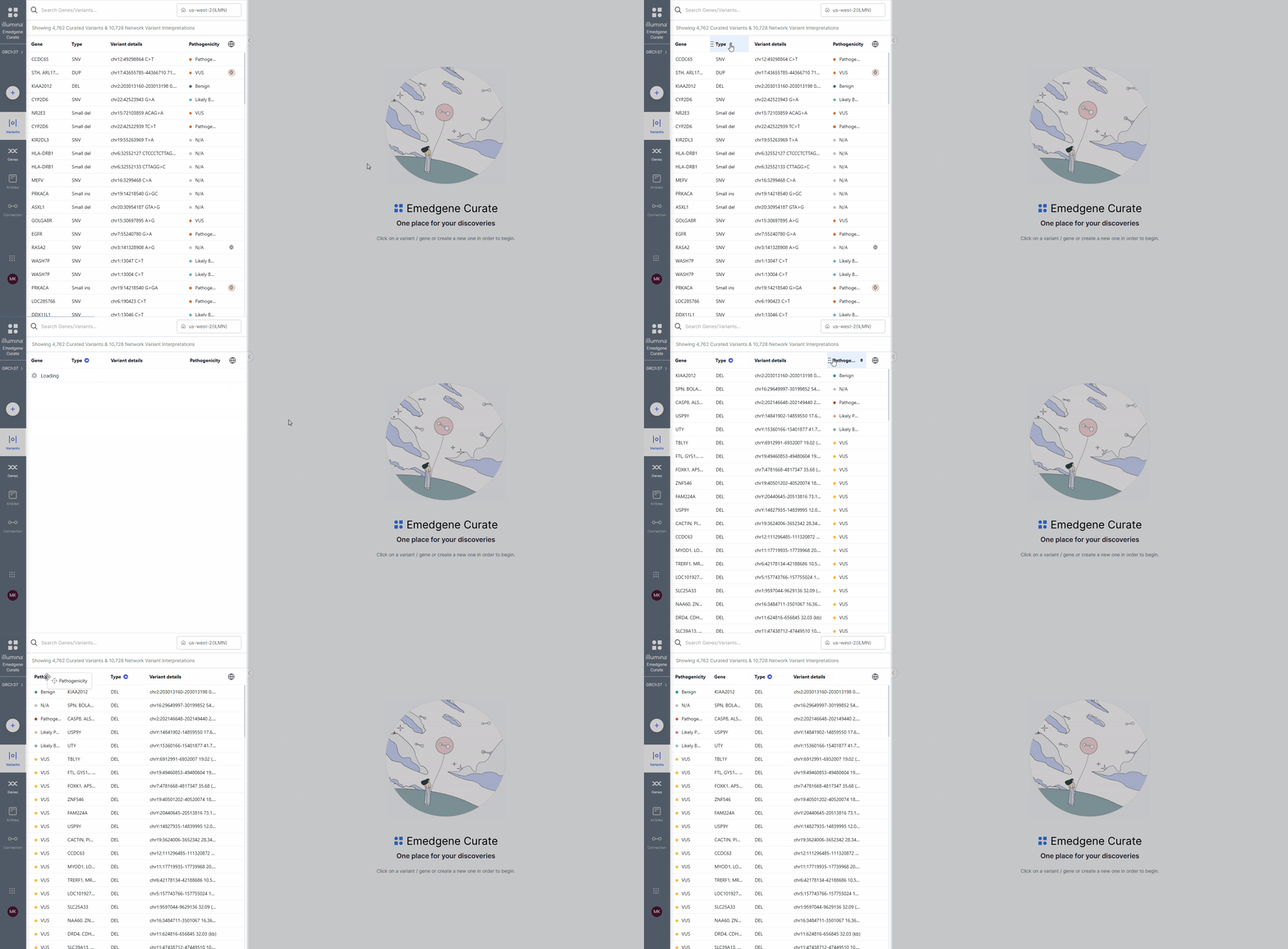
* **Pathogenicity Column** – Indicates the variant's classification (Pathogenic, Likely Pathogenic, VUS, Likely Benign, Benign).
* **Type Column** – Identifies the variant type (e.g., SNV, CNV, STR, SV).
* **Network Column** – Shows if the variant has associated interpretations from connected network organizations.

All columns support **alphabetical or numerical sorting** where applicable for quick navigation.

### **Variant Counts**

To improve clarity when browsing large databases, the Curate interface now shows **real-time counts of curated records**:

* If your organization has a network connection, count text will display both number of total filtered variants from your native Curate database and number of filtered variant interpretations from the connected network (if available).
* If your organization does not have a network connection, count text will display only number of curated variants from your native Curate database.

Note:🔻All the *Curate Variant table* columns allow for alphabetical sorting.

![](https://1131024994-files.gitbook.io/~/files/v0/b/gitbook-x-prod.appspot.com/o/spaces%2FGCW0DnLlE7QjoZPNmKIi%2Fuploads%2Fgit-blob-513653e23dca3fa7bf4746bfdf8e35f5497f5fa6%2Fcurate_variant_table_2_image.png?alt=media)

{% hint style="info" %}
**Note:**

* Counts are now displayed directly **below the search bar**, making it easy to see how many variants are being displayed without scrolling.
  {% endhint %}

{% hint style="success" %}
**Tips:**

* Check the **variant and network interpretation counts** to confirm whether your organization or external sources provide additional context.
* Sort by **pathogenicity** to prioritize clinically significant variants.
  {% endhint %}


---

# Agent Instructions: Querying This Documentation

If you need additional information that is not directly available in this page, you can query the documentation dynamically by asking a question.

Perform an HTTP GET request on the current page URL with the `ask` query parameter:

```
GET https://help.connected.illumina.com/emedgene/emedgene-curate-manual/curate_variants/curate_variant_table.md?ask=<question>
```

The question should be specific, self-contained, and written in natural language.
The response will contain a direct answer to the question and relevant excerpts and sources from the documentation.

Use this mechanism when the answer is not explicitly present in the current page, you need clarification or additional context, or you want to retrieve related documentation sections.
