> For the complete documentation index, see [llms.txt](https://help.connected.illumina.com/llms.txt). Markdown versions of documentation pages are available by appending `.md` to page URLs; this page is available as [Markdown](https://help.connected.illumina.com/icm/analyses/analysis-functionality/task-menu/region-analysis/get-regional-methylation.md).
# Get Regional Methylation
The Get Regional Methylation task uses a region annotation (.bed) file to generate regions from CpG methylation count data. For each region specified in the annotation file, methylation counts of all CpG sites within the region are averaged to produce a count value in a regions-by-samples count matrix.
## Using a built-in promoter regions file
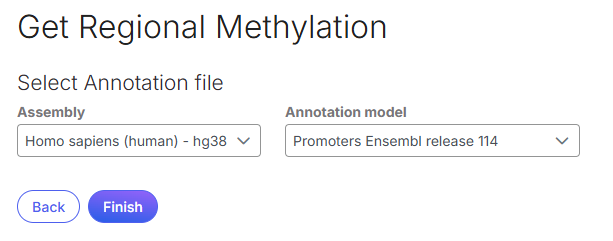
A built-in annotation model based on human (hg38) promoter regions from ENSEMBL version 114 is provided. To invoke Get Regional Methylation task,
* Click on **5-base Methylation** data node.
* Select **Region analysis** from context-sensitive menu, select **Get Regional Methylation**.
* Select **Homo sapiens (human) - hg38** from **Assembly** and **Promoters Ensembl release 114** from **Annotation model** drop-down, then click **Finish**.
* If you do not see 'Promoters Ensembl release 114' from the Annotation model drop-down, following these steps to add the built-in promoter regions annotation:
* select **Add Annotation model** from **Annotation model** drop-down.
* In **Add annotation file** dialog, select **Homo sapiens (human)** at *Species*, **hg38** at *Assembly*, **Promoters Ensembl release 114** at *Annotation model drop-down*, **Download annotation file** at *Creation options*, then click **Create**.
## Using a custom regions file
When you have a list of regions of interest, you may upload a custom region bed file for the Get Regional Methylation task. The custom regions file should:
* Consists of 3 columns: chromosome, start position, and stop position. The positions should be 0-based coordinates.
* No columns name.
* Tab-delimited.
* Saved as .bed file.
After the custom region file is prepared, following these steps to apply it on the Get Regional Methylation task:
* Click on **5-base Methylation** data node.
* Select **Region analysis** from context-sensitive menu, select **Get Regional Methylation**.
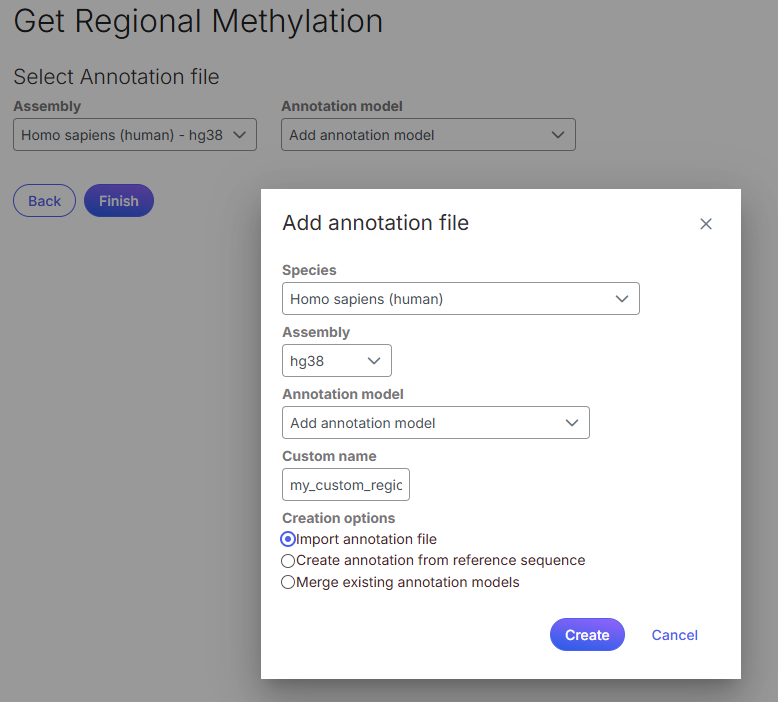
* Select an **Assembly**, and select **Add Annotation model** from **Annotation model** drop-down.
* In **Add annotation file** dialog, select **Add Annotation model** from **Annotation model** drop-down, type in a **name** for the custom annatation, select **Import annotation file**, then click **Create**.
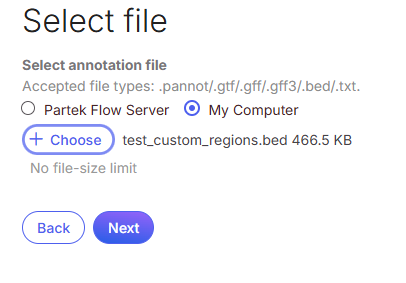
* At **Select file** page, select **My Computer.**
* Click **+ Choose** button to choose a .bed file from your computer.
* The selected file name will be displayed, click **Next**.
* Select **Other** for **Annotation type,** click **Next.**
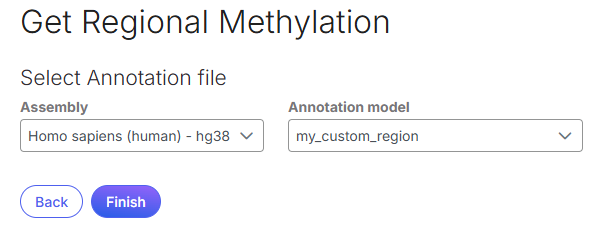
* Click **Finish** to run Get Regional Methylation based on the selected custom regions file.
---
# Agent Instructions
This documentation is published with GitBook. GitBook is the documentation platform designed so that both humans and AI agents can read, navigate, and reason over technical content effectively. Learn more at gitbook.com.
## Querying This Documentation
If you need additional information that is not directly available in this page, you can query the documentation dynamically by asking a question.
Perform an HTTP GET request on the current page URL with the `ask` query parameter, and the optional `goal` query parameter:
```
GET https://help.connected.illumina.com/icm/analyses/analysis-functionality/task-menu/region-analysis/get-regional-methylation.md?ask=&goal=
```
`ask` is the immediate question: it should be specific, self-contained, and written in natural language.
`goal` is optional and describes the broader end goal you are ultimately trying to accomplish on behalf of the user. GitBook uses it to tailor the answer towards what is most useful for that goal.
The response will contain a direct answer to the question and relevant excerpts and sources from the documentation.
Use this mechanism when the answer is not explicitly present in the current page, you need clarification or additional context, or you want to retrieve related documentation sections.